Profile picture of Fred Wieser

I am a researcher at Huawei Noah’s Ark Lab, working in the Reinforcement Learning group on world models, mechanistic interpretability, and continual learning under the guidance of Prof. Jun Wang and Dr. Zafeirios Fountas. My work is broadly about making learning systems more efficient, more adaptive, and better able to reason over long horizons.

I studied Computational Statistics and Machine Learning at UCL. Before that, I completed a BSc in Theoretical Physics, during which I became more interested in computing. After graduating, I spent three years as a software engineer, first in laser technology R&D and then on event-driven trading systems for prediction markets.

Broadly, I want to build data-efficient models that can reason, plan, and adapt beyond their training distribution. My main interests are efficient ML systems, continual learning, mechanistic interpretability, and safe long-horizon AI.

Outside work, I enjoy coding, Formula 1, board games, and art. I am always open to discussing new projects, research ideas, or collaborations; contact me below if you would like to connect.

Research

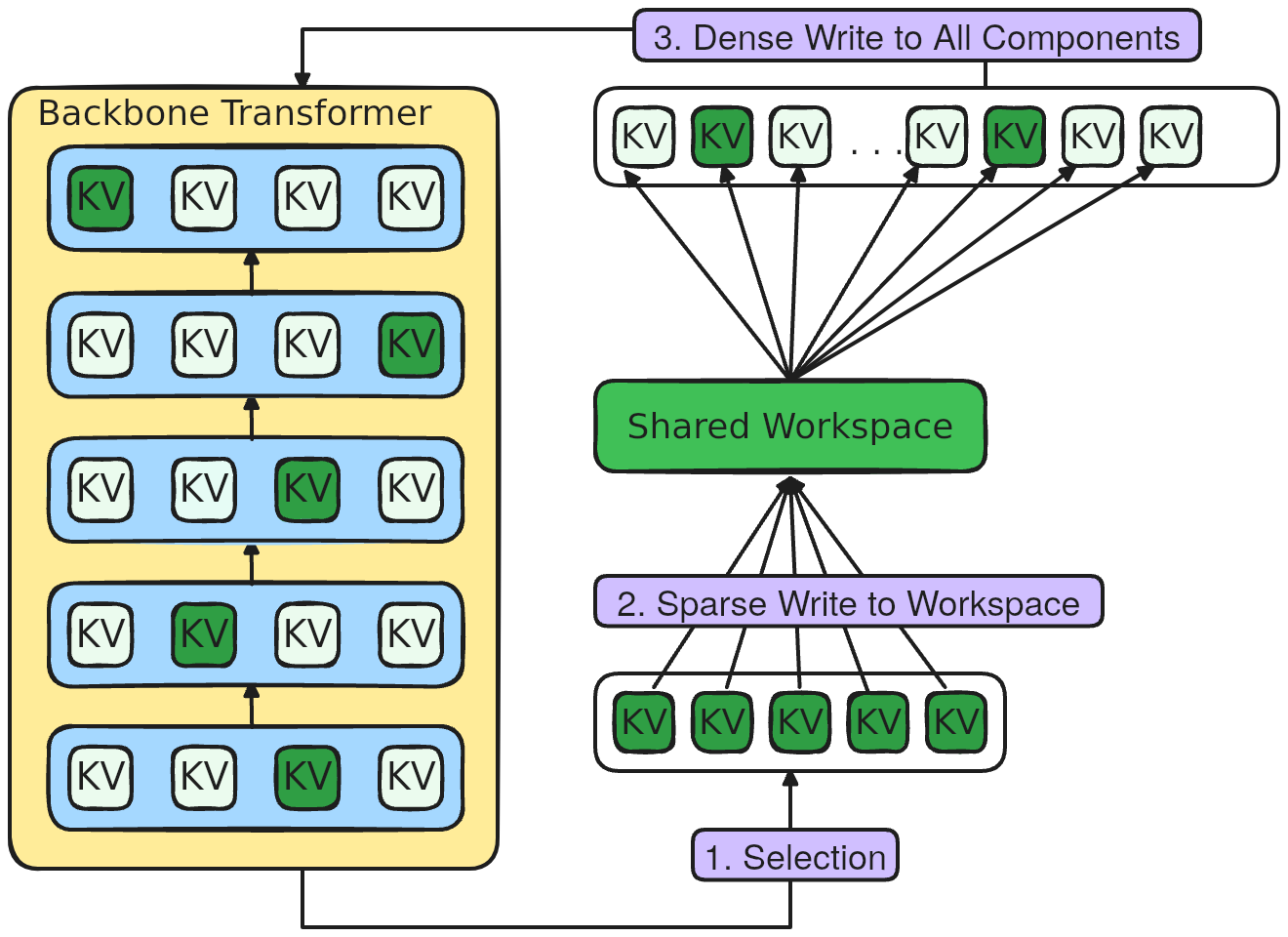
Main figure for The Global Key-Value Workspace

The Global Key-Value Workspace

Zafeirios Fountas, Frederico Wieser, Martin Benfeghoul, Adnan Oomerjee, Jun Wang
Association for the Scientific Study of Consciousness (ASSC) 2026

TLDR: We build an explicit neural global workspace inside an LLM and train it to do mathematical reasoning. We further show that this architecture is scalable through pretraining and that the model increases the synergy of information between its components.

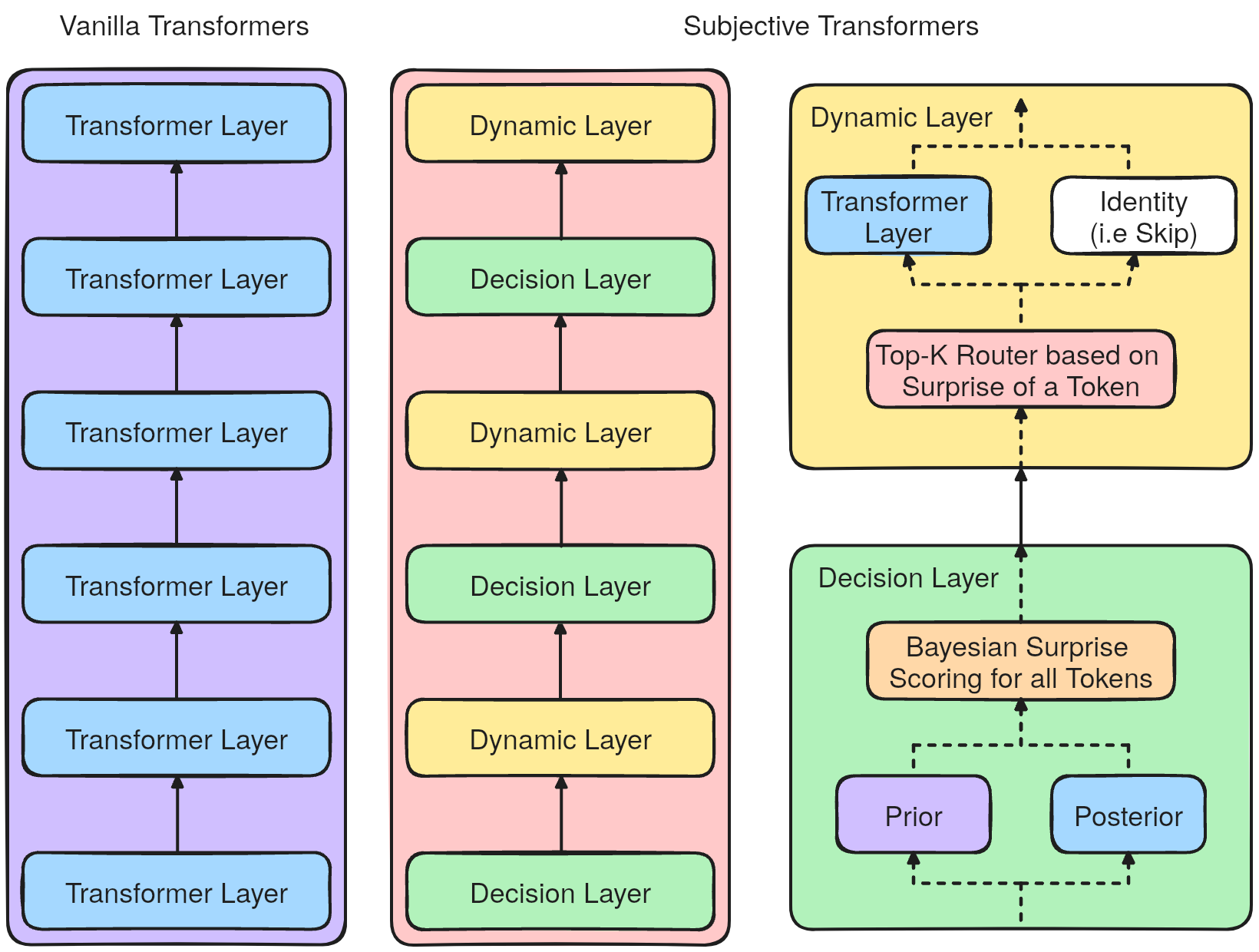
Architecture of the Subjective Depth and Timescale Transformers

Subjective Depth and Timescale Transformers: Learning Where and When to Compute

Frederico Wieser, Martin Benfeghoul, Haitham Bou Ammar, Jun Wang, Zafeirios Fountas
arXiv 2025

TLDR: We build two Transformer architectures that learn where and when to compute using Bayesian surprise. We route tokens through dynamic layers, which either execute or skip Transformer blocks (Attention + MLP) over time. We show the resulting reductions in self-attention computation and KV-cache requirements, as well as the accuracy trade-offs of conditional computation.

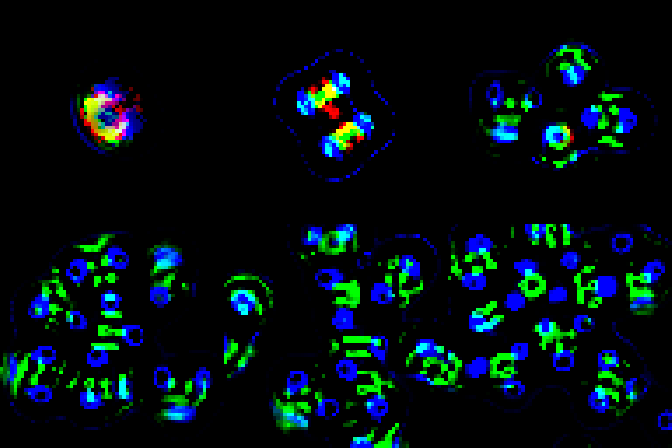
ASAL++ ‘An Egg Hatching’, iteration 5, showing mineral-based bioluminescent symbiotic fungal colonies

Guiding Evolution of Artificial Life Using Vision-Language Models

Nikhil Baid, Hannah Erlebach, Paul Hellegouarch, Frederico Wieser
Artificial Life (ALIFE) 2025
Oral · Outstanding Contribution

TLDR: We build ASAL++, a method that uses multimodal foundation models to guide open-ended-like search through simulations. ASAL++ continuously proposes new targets stochastically based on a simulation's visual history and explores possible evolutionary strategies.

Posts

Contact

Send me a short note, or use one of the email addresses below.

Email addresses: